
 e-mail
 English
 français
 Deutsch
 русский
 italiano
 español
 português
 العربية
 日本語
日本語 한국의
한국의 中文
中文



-
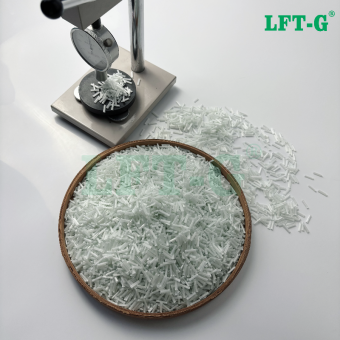
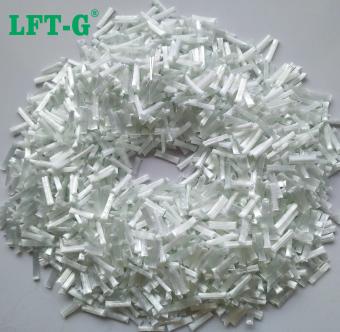
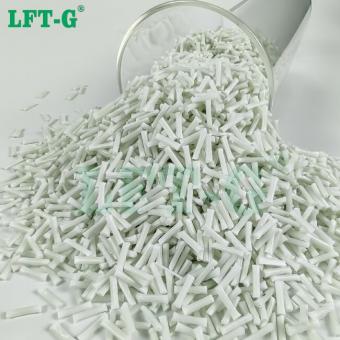
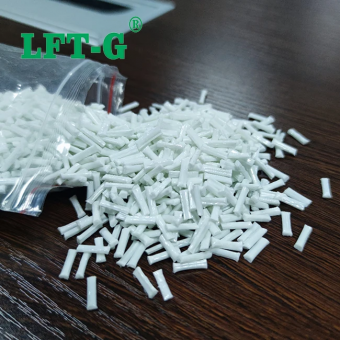
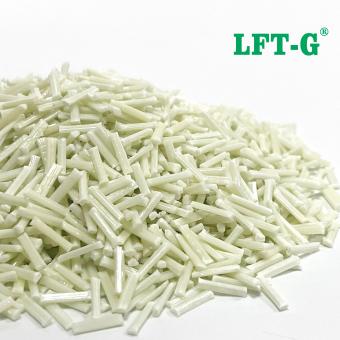
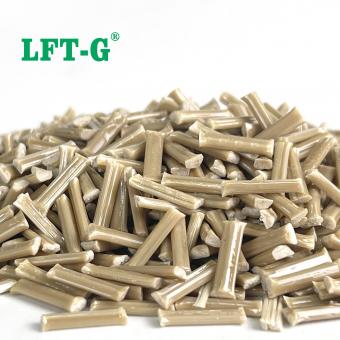
LFT-G PP Polyphenylene blends long carbon fiber thermoplastic resin original color sample available 12mmPP material Polypropylene fiber has remarkable performance. Compared with other fibers, polypropylene fiber has the lightest, warmest and most hydrophobic fiber properties. The density of polypropylene fiber is only 0.91g/cm3, which is the smallest among the five synthetic fibers and about 34% lighter than polyester fiber; the insulation rate of polypropylene fiber is 36.49%, which is the highest among the five synthetic fibers and 1.7 times that of polyester; the standard moisture regain rate of polypropylene fiber is almost zero, and the hydrophobic and moisture-conducting properties are the best. At the same time, polypropylene fiber has good acid and alkali resistance and heat aging properties. PP-LGF reinofrced material Long carbon fiber reinforced composites can solve your problems when other methods of reinforced plastics do not provide the performance you need or if you want to replace metal with plastic. Long carbon fiber reinforced composites offer significant weight savings and provide optimum strength and stiffness properties in reinforced thermoplastics. The excellent mechanical properties of long carbon fiber reinforced composites make it an ideal replacement for metals. Combined with the design and manufacturing advantages of injection molded thermoplastics, long carbon fiber composites simplify the re-imagining of components and equipment with demanding performance requirements. Its widespread use in aerospace and other advanced industries make it and a "high-tech" perception of consumers - you can use it to market products and create differentiation from competitors. Datasheet of PP-LCF Injection molding Aplication of PP-LCF More suitable for large parts and structural parts. Other application fields you can contact us for technical supports. Test 1. Heat Deflection Temperature Testing 2. Vicat Softening Temperature Testing 3. Tensile Testing 4. Flexural Strength Testing 5. Elongation Testing 6. Density Testing 7. Melt Flow Rate Testing 8. Impact Strength Testing. 9. Etc. Production process 1. The original carbon fiber is physically and chemically treated to remove impurities, improve surface activity, and enhance the mechanical properties and durability of the prepreg. 2. Add resin, curing agent, additives, etc. to form a formula to improve fluidity, hardness, and temperature stability. 3. The pretreated carbon fiber is placed on the machine and compounded with resin. 4. The machine solidifies the words and the two are fully bonded. 5. Cut into 5mm-24mm particles according to the needs of manufactured products。 Certification 1. Quality Management System ISO9001/16949 Certification 2. National Laboratory Accreditation Certificate 3. Modified Plastics Innovation Enterprise 4. Honorary Certificate 5. Heavy metal REACH & ROHS testing Frequently asked questions Q. What are the advantages of long carbon fiber materials? A. Thermoplastic LFT long carbon fiber material has high rigidity, good impact strength, low warpage, low shrinkage, electrical conductivity and electrostatic properties, and its mechanical properties are better than glass fiber series. Long carbon fiber has the characteristics of lighter and more convenient processing to replace metal products. Q. Are there any special process requirements of long carbon fiber injection molding products? A. We must consider the requirements of long carbon fiber for the injection molding machine screw nozzle, mold structure and injection molding process. Long carbon fiber is a relatively high cost material, and need to evaluate the cost performance problem in the selection process. Q. The cost of long fiber products is higher. Does it has a high recycling value? A. The thermoplastic LFT long fiber material can be recycled and reused very well
- Long carbon fiber Reinforced Polypropylene for electrial accessories
- self owing pp pellets
- best long carbon fiber pp lcf30 granules
- PLA Composite Pellets
- Modified Plastic pellets
- pp modified granules manufacturer
Tags :
-
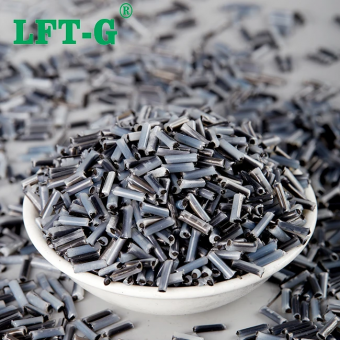
LFT-G high rigidity PLA polylactic acid long carbon fiber reinforced material black color 10-12mm customizedPLA plastic Polylactic acid (PLA) fiber is made from starch raw materials such as corn and wheat, converted into lactic acid by fermentation, and then polymerized to obtain PLA, which is made by solution spinning or melt spinning. It is a fiber that completes the natural cycle and has biodegradability. The fiber does not use petroleum and other chemical materials at all, and its waste can be decomposed into carbon dioxide and water under the action of microorganisms in the soil and seawater, so it will not pollute the earth's environment. Since the initial raw material of this fiber is starch, its regeneration cycle is short, about one to two years, and the carbon dioxide it produces can be reduced in the atmosphere by plant photosynthesis. Long carbon fiber reinofrced PLA Carbon Fiber (CF) is an inorganic fiber containing more than 90% carbon. It is made by cracking carbonization of organic fibers under high temperature environment to form carbon main chain mechanism. As a new generation of reinforcing fibers, carbon fiber has excellent mechanical and chemical properties, including: 1) Light weight. Carbon fiber density and magnesium and beryllium is basically equivalent to less than 1/4 of steel, the use of carbon fiber composites as a structural component material can make the structure quality reduction of 30% -40%. 2) High strength and high modulus. The specific strength of carbon fiber is 5 times higher than that of steel and 4 times higher than that of aluminum alloy; the specific modulus is 1.3-12.3 times higher than that of other structural materials. 3) Small coefficient of expansion. Most of the carbon fiber at room temperature coefficient of thermal expansion is negative, the coefficient of thermal expansion under high temperature conditions is small, it is not easy due to high working temperature and expansion and deformation. 4) Good chemical corrosion resistance. In the acid, alkali environment are very stable performance, can be made into various types of chemical corrosion products. 5)Strong fatigue resistance. Its composite materials by stress fatigue millions of cycle test, strength retention rate is still 60%, while 40% of steel, aluminum for 30%, glass fiber reinforced plastic is only 20% -25%. Carbon fiber composites are the re-enforcement of carbon fiber. Although carbon fiber can be used alone and play a specific function, however, it is ultimately a brittle material, only with the combination of matrix materials to form carbon fiber composites, in order to better play the mechanical properties, to carry more load. Long carbon fiber & Short carbon fiber Long carbon fiber (LGF): 6-25mm/ High performance, high cost Short carbon fiber (SCF): less than 6mm/ Low performance, low cost In the composite material made of fibers is sheared or pulled, the fibers are pulled out from the matrix, such a pulling process is conducive to the absorption of energy provided by the loading, the longer the fibers are within a certain length, the greater the absorption of energy, and the more significant its strength. And in the same volume amount, due to the longer the single fiber, the fewer the number of fiber roots, the less stress concentration generated at the fiber end, the more difficult the destruction of the material. From the results of the feedback of practical applications, the various properties of long carbon fiber reinforced thermoplastic composites are more excellent than those of short fibers. ●Will the use of Xiamen LFT-G materials increase the cost? a. The unit cost of the material is slightly higher than aluminum alloy, but the cost/time of secondary metal processing can be saved, which is relatively advantageous overall. b. The unit cost of the material is slightly higher than that of a homogeneous staple fiber reinforced composite material, but LFRT has high dimensional stability, is not easily deformed, and can be assembled after demolding, which saves cooling/pressure retention time for molding and cost/time for fixing fixtures. Product processing Warehouse & laboratory Main products
- Long carbon fiber Reinforced PLA for electrial accessories
- Injection molded PLA green materials lcf
- PLA Composite Pellets long carbon fiber filled
- PLA modified plastic instead metal
- pla polymers pellets long fiber
- LFT-G pla high mechanical properties
Tags :
-
Xiamen LFT-G PP Polyphenylene with long carbon fiber thermoplastic resin original colorPP material Polypropylene fiber has remarkable performance. Compared with other fibers, polypropylene fiber has the lightest, warmest and most hydrophobic fiber properties. The density of polypropylene fiber is only 0.91g/cm3, which is the smallest among the five synthetic fibers and about 34% lighter than polyester fiber; the insulation rate of polypropylene fiber is 36.49%, which is the highest among the five synthetic fibers and 1.7 times that of polyester; the standard moisture regain rate of polypropylene fiber is almost zero, and the hydrophobic and moisture-conducting properties are the best. At the same time, polypropylene fiber has good acid and alkali resistance and heat aging properties. PP-LGF reinofrced material Long carbon fiber reinforced composites can solve your problems when other methods of reinforced plastics do not provide the performance you need or if you want to replace metal with plastic. Long carbon fiber reinforced composites offer significant weight savings and provide optimum strength and stiffness properties in reinforced thermoplastics. The excellent mechanical properties of long carbon fiber reinforced composites make it an ideal replacement for metals. Combined with the design and manufacturing advantages of injection molded thermoplastics, long carbon fiber composites simplify the re-imagining of components and equipment with demanding performance requirements. Its widespread use in aerospace and other advanced industries make it and a "high-tech" perception of consumers - you can use it to market products and create differentiation from competitors. Datasheet of PP-LCF Injection molding Aplication of PP-LCF More suitable for large parts and structural parts. Other application fields you can contact us for technical supports. Test 1. Heat Deflection Temperature Testing 2. Vicat Softening Temperature Testing 3. Tensile Testing 4. Flexural Strength Testing 5. Elongation Testing 6. Density Testing 7. Melt Flow Rate Testing 8. Impact Strength Testing. 9. Etc. Production process 1. The original carbon fiber is physically and chemically treated to remove impurities, improve surface activity, and enhance the mechanical properties and durability of the prepreg. 2. Add resin, curing agent, additives, etc. to form a formula to improve fluidity, hardness, and temperature stability. 3. The pretreated carbon fiber is placed on the machine and compounded with resin. 4. The machine solidifies the words and the two are fully bonded. 5. Cut into 5mm-24mm particles according to the needs of manufactured products。 Certification 1. Quality Management System ISO9001/16949 Certification 2. National Laboratory Accreditation Certificate 3. Modified Plastics Innovation Enterprise 4. Honorary Certificate 5. Heavy metal REACH & ROHS testing Frequently asked questions Q. What are the advantages of long carbon fiber materials? A. Thermoplastic LFT long carbon fiber material has high rigidity, good impact strength, low warpage, low shrinkage, electrical conductivity and electrostatic properties, and its mechanical properties are better than glass fiber series. Long carbon fiber has the characteristics of lighter and more convenient processing to replace metal products. Q. Are there any special process requirements of long carbon fiber injection molding products? A. We must consider the requirements of long carbon fiber for the injection molding machine screw nozzle, mold structure and injection molding process. Long carbon fiber is a relatively high cost material, and need to evaluate the cost performance problem in the selection process. Q. The cost of long fiber products is higher. Does it has a high recycling value? A. The thermoplastic LFT long fiber material can be recycled and reused very well
- self owing pp pellets producer whole sell
- PLA Composite Pellets good price made in China
- Modified Plastic pellets home appliances resin
Tags :

